

5 Ways to Practice Conscious Kindness Day to Day
Small, real practices — not another thing to get right, just a gentler way to be with yourself.
Conscious Kindness isn’t a technique you master once and move on from — it’s a practice, something you return to daily, often imperfectly. If you want the fuller picture of where this framework comes from and why it matters, I’ve written about that in depth in Conscious Kindness: A Compassionate Response to the Harsh Inner Critic. This piece is shorter and more practical — five real things you can actually do, starting today.
1. Conscious Kindness in Practice: Notice the Voice, Don’t Fuse With It
In Psychosynthesis, this practice has a name: disidentification. The harsh inner critic is a subpersonality — a part of you, formed for real reasons, usually protective ones, but not the whole of who you are. The practice isn’t about suppression, and it isn’t inner argument; both of these keep you fused with the critical voice, reacting from inside it. Instead, the work is to witness it: “I notice my critic is active.” That small shift in language — from I am to I notice — creates real psychological distance, the same distance that makes genuine choice possible rather than automatic reaction. This resonates with evidence-based approaches like CBT, which work similarly with noticing and stepping back from automatic thoughts, though the underlying theory here comes from Psychosynthesis specifically.
2. Extending Unconditional Positive Regard to Yourself
Carl Rogers argued that unconditional positive regard — acceptance without the condition of first being “good enough” — is what makes therapeutic change possible. Most of us extend that regard (i.e. non-judgement) readily to people we love, and rarely to ourselves. The practice here is deliberately asking, in the moment of self-criticism: would I offer this same judgement to someone I hold in genuine regard? If not, the task isn’t to suppress the criticism, but to notice the double standard, and consciously choose the same regard for yourself that you already know how to give.
3. Somatic Self-Soothing: Working with the Nervous System, Not Just the Mind
Self-criticism isn’t only cognitive — it registers in the body as genuine physiological threat, activating the same nervous system responses as real danger. Polyvagal-informed practice recognises that co-regulation — feeling genuinely safe with another person, or with a trusted internal sense of self — can down-regulate that threat response directly. This is part of what makes Conscious Kindness a genuinely embodied practice, not just a cognitive one. A hand placed on the chest, paired with a brief acknowledgement such as “this is hard right now,” isn’t a symbolic gesture; it’s a way of signalling safety to the nervous system itself, distinct from, and often more immediate than, any cognitive reframe.
4. Working with the Subpersonality’s Underlying Need
The harsh critic rarely exists without purpose. It typically formed to protect you — from rejection, from failure, from repeating an old wound — even when its methods are now counterproductive. Rather than treating the critic as an enemy to silence, Psychosynthesis practice asks what it’s actually trying to protect, and what would meet that underlying need more skilfully than harshness does. This is genuinely different from generic self-help reframing: it takes the critic’s function seriously, rather than dismissing it, while still refusing to let it dictate how you’re treated.
5. Conscious Kindness Through Repetition
Self-compassion, like any capacity, develops through repeated practice rather than insight alone — a single moment of understanding rarely changes an ingrained pattern on its own. A brief evening practice of naming one instance of genuine care or effort, however small, works precisely because of its repetition, not its content. Over time, this doesn’t just build a habit; it gradually shifts the default relationship you have with yourself, from vigilant self-monitoring toward something closer to trust.
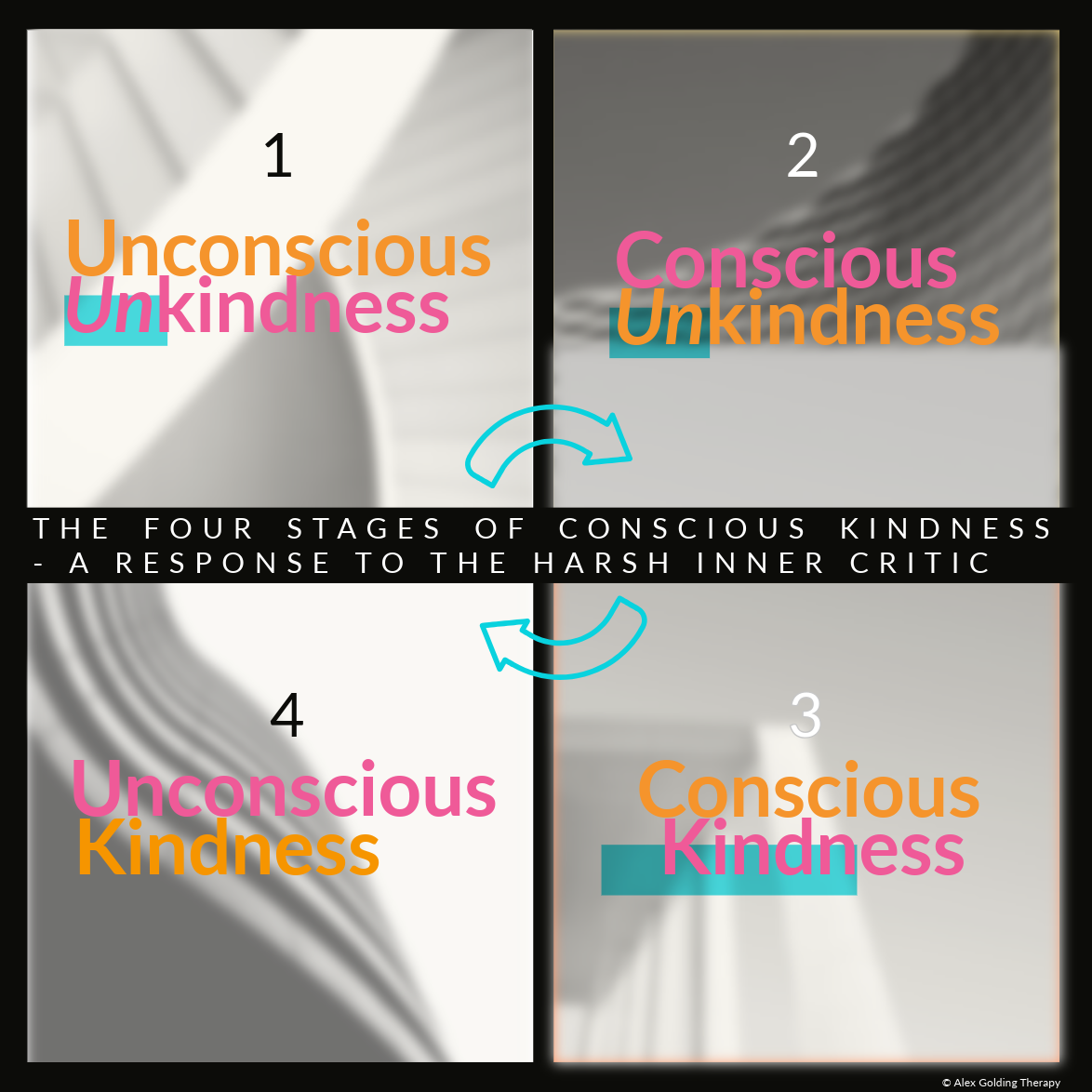

The five practices above touch on each of these four stages — the full article walks through the complete framework in depth.
None of this is quick, and none of it requires you to already believe you deserve kindness — that belief tends to follow the practice, not precede it. If you’d like to explore where the Conscious Kindness framework comes from, and how it connects more fully to the harsh inner critic and Psychosynthesis theory, the full article goes considerably further into the origins and depth behind it.
What to Expect
Format: Individual 50-minute sessions, weekly
Where: In person in Farringdon, London (recommended where possible), Streatham (Tuesdays, 9am–3pm), or online for those based outside London
Starting out: A free 15-minute consultation is available first, if you’d like to ask questions before committing to a full session
Fees: £70 per session


Alex Golding
BACP-Registered Psychosynthesis Counsellor
Ready to Talk?
Ready to start, or want to ask a question first — either way, I’d be glad to hear from you.