



Conscious Kindness: A Compassionate Response to Our Harsh Inner Critic
“We cannot change, we cannot move away from what we are, until we thoroughly accept what we are. Then change seems to come about almost unnoticed.”
Carl Rogers, On Becoming a Person
There is a voice that follows many people throughout their lives. Sometimes it appears as self-doubt; we tell ourselves that we are not enough, or too much. Other times as perfectionism or trying to match ideal versions of ourselves, often in the form of ‘shoulds’. Sometimes as anxiety, shame or a relentless pressure to prove ourselves. Perhaps you have heard this voice quietly, or loudly – even incessantly – commenting on your every move; your mistakes, shortfalls, constantly comparing with others. Such judgements remind us of what we should have done, should be doing or should have become by now.
When this becomes so familiar to the point where we no longer recognise it as a voice at all, it simply feels like reality, truth or how the world is. In psychotherapy, this voice is often described as the harsh inner critic. It sits behind many of the difficulties that bring people into therapy, governing over low self-esteem, people-pleasing, perfectionism, burnout, depression, and relationship difficulties – a persistent feeling of never quite being enough. Yet despite its prevalence within the psyche, this harsh inner critic is rarely the real problem. More often, it is a symptom of something deeper.
People sometimes assume the goal of therapy is to get rid of the critic altogether. In my experience, this is neither realistic nor particularly helpful. Our inner critic developed for a very good reason, so trashing it (even if that were possible) would leave us totally unprepared. For example, it helped us stay safe, avoid rejection, gain approval or maintain important relationships in early life, in order to survive. The difficulty arises when strategies that once worked to protect us continue operating long after their original need has passed.
Psychosynthesis therapy with me offers a compassionate way of understanding and working through this. Rather than seeing the critic as an enemy, psychosynthesis views it as one aspect of a wider survival personality: a collection of adaptations that developed to help us navigate our early world.
“Survival personality is fundamentally a broken empathy with ourselves, a truncation of our authentic experience of ourselves, the world, and the Divine.”
Firman & Gila, Psychosynthesis – A Psychology of the Spirit
These adaptations may once have been necessary. However, as adults they can become restrictive, limiting our spontaneity, authenticity and capacity for genuine connection. They may be likened to an old, outdated operating system that could benefit from an upgrade. Healing therefore becomes less about fighting parts of ourselves and more about understanding them. Through awareness, we begin recognising that the critic is only one voice within a much larger and richer inner landscape.
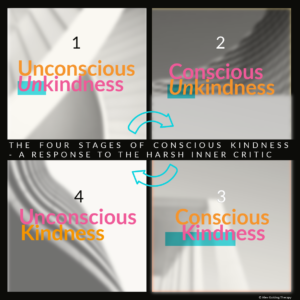
This article explores what I call Conscious Kindness, a framework inspired by the Four Stages of Competence model. The Conscious Kindness model I’ve developed, begins with developing our awareness, it describes how we move from unconsciously criticising ourselves towards a more compassionate, integrated and authentic way of living. Along the way we will explore shame, low self-esteem, people-pleasing, adaptation, self-compassion and the journey from survival towards selfhood, or what Carl Jung called individuation, and how psychosynthesis therapy helps with this.
The Four Stages of Competence and Emotional Growth
The original Four Stages of Competence model was developed to explain how people learn new skills. At first we do not know what we do not know. Then we become aware of our limitations. With practice we improve, and eventually the skill becomes second nature. Learning to drive provides a familiar example. Initially we are unaware of how much there is to learn. Later we become painfully conscious of every mistake. Eventually the process becomes natural and intuitive. This applies to mastering any field, art, skill or craft.
I have observed a similar process occurring through the journey of therapy, particularly in the way we relate to ourselves. The journey of conscious kindness follows through the following four stages: Unconscious Unkindness, Conscious Unkindness, Conscious Kindness and Unconscious Kindness. At first we are unaware of how harshly we treat ourselves. Then awareness emerges. We begin hearing the critic, noticing its impact. Gradually we learn new ways of responding. Eventually kindness becomes less technique and a more natural way of relating to ourselves. We get better at living with aliveness.
The journey is rarely linear. Most of us move backwards and forwards between these stages throughout life. Nevertheless, this framework provides a useful map of what healing often involves.
Stage One: Unconscious Unkindness

Many clients come to therapy simply because they want to feel better. At that point they may not realise that they have a very harsh inner critic. They have what CBT calls, automatic thoughts.
One of the most striking features of the harsh inner critic is how invisible it can become. We have lived with it for so long that we assume its voice is speaking THE truth. Judgements feel factual. The assumptions feel obvious. The conclusions appear beyond question. And that is the trap, or illusion. Thoughts such as “You’ll never be successful”, “You always mess things up”, “What’s wrong with you? Why can’t you be like everybody else?” or “You should be coping better than this; stop over-thinking” can become so familiar that they no longer feel like opinions. They feel like truth.
But what if we begin to ask where these messages originated? We find they have been repeated so often that they become a blur, woven into identity itself. They erode our confidence, our right to be a distinct, acceptable individual. So familiar, we hear them internally and assume they are our own voice. Yet many of these beliefs began elsewhere. In psychotherapy, such messages are often called introjects. An introject is a belief, value or attitude absorbed from the outside world and taken inside as though it belongs to us. Parents, teachers, peers, cultural expectations, religion, relationships and wider society all contribute to the formation of these internal messages.
Over time, external voices become internal voices. The problem is that for whatever reason, our ability to filter such disapproving judgements did not develop adequately enough, leaving us to effectively swallow them whole, unchallenged as truths. A child who repeatedly hears criticism may grow into an adult who constantly criticises themselves. A child praised only for achievement may learn that their worth depends upon performance. Another may discover that vulnerability is unwelcome and conclude that emotional needs should remain hidden.
Much of this, however, is unconscious. We may have explicitly heard these messages or phrases, or they may have been subtly conveyed. Over time these messages become automatic, shaping our behaviour long after the original circumstances have passed. And the critic thrives upon remaining unquestioned. Consequently, one important question when statements come up in therapy is simply: Whose voice is this speaking? Closely followed by another equally important consideration: Is it actually true?
Stage Two: Conscious Unkindness
If Unconscious Unkindness is characterised by believing the critic, Conscious Unkindness begins when we hear it.
This can be an uncomfortable stage. Some people may actually feel worse when they initially become aware of their inner critic. Before, the voice operated in the background. Now it becomes harder to ignore. Thoughts that once seemed normal suddenly reveal themselves as surprisingly harsh. But it is illuminating also. You might notice how often you dismiss compliments. Perhaps you minimise achievements, compare yourself unfavourably to others, or speak to yourself in ways you would never dream of speaking to somebody you love. You begin recognising how much of your energy is devoted to proving yourself, protecting yourself, ruminating or avoiding disapproval.
Awareness is often the beginning of change. Though initially unsettling, it provides a significant turning point. We cannot change what remains unconscious. Many clients experience this stage as a gradual awakening. They begin noticing patterns that have shaped their lives for years. The perfectionism that once appeared as being responsible, now looks exhausting. The people-pleasing that once seemed caring starts to feel costly. Or the relentless striving that once promised fulfilment begins to unravel, as need for something deeper. We can also see how these unhelpful patterns unconsciously persisted to keep us trapped where we are. We also begin to acknowledge that they may have served us rather conveniently, to justify our anger, fear, identity or story.
The Search for Validation
One of the most common consequences of a harsh inner critic is the belief that our worth depends upon external validation. If we achieve enough, perhaps we will finally feel enough. When we succeed enough, perhaps we will finally relax. If we are attractive enough, productive enough, helpful enough, successful enough or admired enough, perhaps the critic will finally fall silent and we will be content. Yet it rarely works that way. Many people discover that no achievement feels sufficient for very long. The goalposts move. Or the grass is greener. The standards change. Or the critic quickly finds something else that requires improvement.
Pioneer of Person Centred Therapy, Carl Rogers stressed the importance of developing an ‘internal locus of evaluation’ to regain our agency, by rebalancing our reliance upon external approval. In simple terms, this means learning to trust our own experience rather than constantly looking outside ourselves for confirmation that we are acceptable. This kind of self-regard is the natural outcome of effective therapy, the kernel of claiming back our inner power:
“[We] move away from facades, pretence, defensiveness, putting up a front… from “oughts”… meeting the expectations of others, pleasing others as a goal in itself. Being real…self-direction…one’s own feelings… come to be positively valued. [We] come to value an openness to all [our] inner and outer experience.”
Carl Rogers, On Becoming A Person
But change is easier said than done. Difficulties in the therapy journey arise, one where clients may wish to quit therapy, or start becoming dissatisfied with the process. However, continuing is key. Inner transformation is a gradual, organic process. If our sense of worth has been built upon approval, achievement or acceptance, stepping away from those sources (our stories) of validation can feel frightening. It may even feel irresponsible, or indulgent. We may cling to our outmoded sense of control at all costs. Yet without this shift, life can become an endless attempt to satisfy expectations that never truly belong to us. And the critic thrives whenever worth becomes conditional. Therapy often begins helping people ask a different question:
Who am I when I stop trying to prove myself, stop over-compensating?


People-Pleasing and the Fear of Disappointment
People-pleasing is frequently misunderstood. From the outside it may appear generous, caring or considerate. Sometimes it is. However, beneath chronic people-pleasing there is often anxiety – or a need for control. The anxiety of disappointing others. The anxiety of conflict. A fear of rejection. Or the emptiness of no longer being needed. There is a cost we pay when we move away from being who we actually are.
Perhaps very early on we learnt that maintaining harmony, or to fit in was important. Maybe we grew up in environments where expressing needs or difference felt risky. We may have discovered for example that being helpful, agreeable or accommodating brought approval and connection. Whilst these adaptations would make sense. the problem arises when they become automatic. A person may become highly skilled at recognising everybody else’s needs while losing touch with their own. Crucially, they may struggle to set boundaries, or fear saying no. They may find themselves feeling resentful, exhausted or emotionally invisible.
Ironically, the very strategy designed to preserve connection can eventually undermine it. Relationships become based upon adaptation rather than authenticity. Genuine intimacy becomes difficult because other people never fully meet the real person beneath the performance. True connection requires vulnerability. Yet being seen for who we actually are involves a level of risk. Vulnerability then becomes impossible, because we are constantly managing how we appear. Learning how to become more authentic in your relationships is something I often work with. Therapy with me is often a practice in addressing this both safely and relationally.
“People have two basic needs. attachment and authenticity. when authenticity threatens attachment… attachment trumps authenticity.”
Gabor Mate, The Myth of Normal
The False Self and the Cost of Adaptation – Understanding the Harsh Inner Critic
British psychoanalyst Donald Winnicott described what he called the False Self: the ways we learn to adapt to the expectations of others, often at the cost of losing touch with our own spontaneity, vitality and deeper sense of authenticity. This False Self is not necessarily dramatic. It can look highly successful. It can be accomplished, capable and admired. Yet beneath the surface there is often a sense of emptiness, disconnection or fatigue.
Years of adaptation can create distance from our deeper feelings, values, needs and desires. We become skilled at performing a version of ourselves that gains acceptance while neglecting the person we actually are. We find ourselves in relationships we never really asked for, struggle to assert ourselves or drifting along, putting off change because separation feels so frightful. We get used to abandoning ourselves, but this too may also be learnt behaviour. Often clients come to therapy having lost contact with who they are and re-establishing this is one of their prime goals of therapy.
Gabor Maté expresses powerfully what is known that many of us choose attachment over authenticity, because attachment is essential for survival. As children, this choice is understandable. As adults, however, continuing to sacrifice authenticity has come at a considerable cost. Therapy forces us to confront our behaviours and bring awareness with compassion. We begin choosing a different, more desired response, rather than habitually act out our historic patterns. And psychosynthesis frequently involves rediscovering (and ultimately synthesising) the parts of ourselves that were pushed into the background long ago.
“We can take the theory of compensation as a basic law of psychic behaviour. Too little on one side results in too much on the other. Similarly, the relation between conscious and unconscious is compensatory. . .[However] the dissociation of personality, the anxious division of the day-time and the night-time sides of the psyche, cease with progressive assimilation.”
Carl Jung, 1931
Jung, Compensation and the Parts We Leave Behind


Carl Jung recognised that human beings are rarely as simple as they appear. Beneath our conscious identity lies a much larger inner world, containing feelings, qualities and potentials that may have been neglected or pushed aside. He observed that many of our patterns are compensatory. If vulnerability feels unsafe, we may become fiercely self-reliant. If uncertainty feels threatening, we may seek control. If rejection feels likely, we may become overly accommodating. The harsh inner critic often develops within this system, attempting to keep life organised, predictable and safe. Yet in doing so, other qualities can gradually recede into the background.
Creativity, playfulness, tenderness, spontaneity, curiosity and joy do not disappear. They simply become less available. Part of psychological healing involves inviting these qualities back into awareness, not because they are more important than the critic, but because a healthy personality requires balance. When one part dominates, life narrows. As more of ourselves become available, life expands. We find ourselves more present, better able to be in authentic relationship with both ourselves and others. Gradually, relationship itself becomes less threatening and more deeply satisfying.
The Cultural Critic – Our Harsh Inner Critic In Context
Early relationships and personal experiences matter deeply, but they are only part of the story. Our harsh inner critic did not develop in isolation. We are social beings shaped by the wider culture in which we live. The messages we receive about success, strength, productivity and belonging are gradually absorbed into our inner world, becoming standards against which we measure ourselves. Over time, what begins as external pressure can become an internal voice that no longer feels like an opinion, but simply the way things are.
From a wider perspective, we are shaped not only by our personal history but also by collective and cultural forces. Race, gender, economics, politics, ecology and our need to belong all influence how we experience ourselves and the world. Taking these wider influences into account helps us understand ourselves with greater compassion. We recognise that many struggles are understandable responses to intergenerational or collective trauma. As a therapist, I take context into account when considering clients’ presenting issues, with regard to race, gender, sexuality or any difference.
Modern Western society often rewards individual achievement, productivity, competition and measurable success at the expense of connection or community. From an early age we are encouraged to compare, perform and optimise. Social media amplifies these pressures further, creating endless opportunities to evaluate ourselves against carefully curated images of other people’s lives. None of this is entirely new. Yet the intensity has increased. Psychiatrist and philosopher Iain McGilchrist argues that contemporary culture increasingly prioritises left brain forms of thinking associated with control, measurement and analysis while neglecting broader right brain ways. These ways of knowing are rooted in relationship, meaning, context and lived experience.
Consequently, we can become disconnected from our own values while remaining highly attuned to external expectations, perpetuating conditions where our inner critic flourishes. However, developing awareness and a felt sense of our essential more fundamental self creates a choice. Once we begin recognising these influences we can respond differently by deciding which voices genuinely deserve our attention and nurturing. We make a shift that marks the beginning of the next stage: Conscious Kindness.

Stage Three: Conscious Kindness
Conscious Kindness begins with responding differently. Not by pretending everything is fine, or replacing every critical thought with positive affirmations. But rather, accentuating genuine self-compassion which is often far more effective and true than our habitual self-criticism. This allows us to acknowledge our struggles without reducing ourselves to them. It allows us to recognise mistakes without berating ourselves for personal failure. We begin to trust and honour ourselves more deeply, transforming a shame-based mindset to a more robust, empowered one.
We might at this stage, begin noticing that familiar voice and gently question it, for example. Instead of automatically believing every criticism, we learn to pause, or become curious. We might then ask ourselves whether what we are hearing is actually true, whether it is helpful. Or perhaps most importantly, whether it belongs to the present moment or to an earlier chapter in life. We challenge our ‘absolute thinking’ that is often so debilitating.
Someone who has spent years believing they always fail may begin recognising moments of resilience and competence. Another person may notice how quickly they dismiss their strengths while magnifying perceived shortcomings. They may stop comparing and despairing. Others begin questioning deeply rooted assumptions such as “I must always be strong”, “I shouldn’t need help” or “My needs don’t matter”. This is the kind of work we do together in therapy to bring about a kinder response.
Importantly, Conscious Kindness does not attack the harsh inner critic. It seeks to understand it. One of the most transformative questions we can ask is: What is this part trying to do for me? Often the answer reveals something important. The critic may be trying to please our parents, protect us from rejection, or attempting to prevent embarrassment. It may be trying to help us succeed or to keep us safe from emotional pain. Its methods may be harsh. Yet its original intention was often protective.
From Survival to Self –
Psychosynthesis therapy with me offers a profoundly hopeful understanding of psychological growth. Roberto Assagioli recognised that human beings are made up of many different parts, drives, needs and potentials. We are not a single, fixed identity. Rather, we are a dynamic collection of experiences, feelings, roles and crucially, subpersonalities. One damning aspect of the harsh inner critic is the shaming sense it gives that we are damaged, broken or fundamentally wrong at the core.
But the harsh inner critic is one such part of many. So too is the people-pleaser. The achiever. The caretaker. Or the perfectionist. The rebel, or frightened child. The creative dreamer. Or the wise observer. The problem arises when one part dominates the entire personality and we believe this is all we actually are. Many people arrive in therapy believing they are the critic, trusting it’s voice almost implicitly. Through psychosynthesis they gradually discover something different. The critic is simply one magnified part of who they are. It can be dialled down, whilst others are allowed more to the fore.
This distinction changes everything. When we are identified with the critic its voice becomes reality, but when we begin observing it, space emerges. We discover other parts of ourselves have been waiting patiently in the background. Or crying from the shadows to be heard. Some may be wreaking havoc, leaking through our plans, an effort to be seen, allowed to actually live. Some aspects of Self may have been habitually dismissed or even banished for years. These include our anger, pain, resentment, frustration, as well as compassion, creativity, playfulness, tenderness, authenticity or love.
Therapy therefore becomes less about removing parts and more about creating a healthier relationship between them. Like the different instruments of an orchestra working together, each with a role to play. The goal is not perfection or domination, but rather integration. Mate observes that Trauma disconnects. This is why trauma survivors experience such a harsh inner critic, and why they can benefit greatly from undertaking the four stages of conscious kindness. Healing involves restoring relationship with those neglected aspects of our humanity or vulnerability that had to be hidden, rejected or sacrificed in order to belong. This is what we do together.


From Potential to Manifestation – Being Rather Than Constantly Doing
Many people come to therapy exhausted. Not because they are lazy, but actually quite the opposite. They have spent years trying harder, working harder, achieving more, pushing through, holding everything together – at significant cost. Somehow despite all the efforts and potential, their hoped-for sense of peace or progress remains elusive. The same, unwanted patterns emerge. Perhaps the modern culture we live in, but also internalised messages closer to home encouraged us to build our identity around doing rather than being. Often, the what we are became more valued than the who we are, originally by others but more fundamentally, by ourselves.
Perhaps we were taught to measure ourselves by productivity, status, achievement and performance. Consequently, we learnt to value ourselves for what we accomplish rather than who we are. And the harsh inner critic thrives within this environment. There is always more to do. Another target. Another goal or standard to meet. Yet genuine wellbeing rarely emerges for us from endless striving. Sure we need to strive for improvement meet our growing edges, be all we can. But how do we find the balance that works? How do we stay present to this moment – as we are?
Thomas Moore in his illuminating book ‘Care of the Soul‘ writes that the soul asks for depth rather than speed. It seeks meaning rather than mere efficiency. Similarly, many wisdom traditions remind us that fulfilment is found not simply through achievement but through remaining present, to relationship and connection. When we begin cultivating self-compassion, we often discover something surprising. We become more productive, not less. More creative, not less or more resilient. Our energy previously consumed by self-criticism becomes more available for living. We begin to fundamentally hear ourselves and harmonise with who we actually are. We can shine in our truth. And fundamentally, we can become less who we are not.
None of this is easy, or smooth. Much of it is trial and error. One of my favourite psychosynthesis quotes says:
“We are both Being and Becoming in the same breath”
Diana Whitmore, Psychosynthesis Counselling in Action
I like this because it speaks to a quality of the soul’s journey, of our growth in each moment, of our being. The acknowledgement and integration of who we are even if that is or feels unsure, or incomplete. There is a permission, a compassion, acceptance. And in my view, it is acceptance that leads to change. Or perhaps more accurately, it is change in itself, as Carl Rogers states earlier in this piece. So growth and acceptance are not opposites. In fact, the healthiest forms of growth often emerge from self-acceptance.
The Courage to Be Vulnerable
For many people, Conscious Kindness involves developing a different relationship with vulnerability. Our culture often rewards strength, certainty and control, frequently along rigid and limiting lines. Whether because of gender expectations, neurodiversity, disability, ethnicity, sexuality or simply the need to fit in, many people learn to hide aspects of themselves that feel tender, uncertain or different. Consequently, vulnerability can come to feel unsafe, and authenticity something to be managed rather than lived.
Brené Brown’s work stresses that vulnerability is not weakness; it is the birthplace of connection, courage and authenticity. We can begin to become rather than dismiss who we are. Many clients initially fear that becoming kinder to themselves will make them complacent. But instead by risking a deeper level of self-trust and self-compassion, they discover the opposite. Self-compassion creates the safety required for honesty. They create a brave space to contend the outmoded scripts that no longer serve them. They themselves become the authority. Truth comes from their more solid, inner experience.
When we no longer need to defend ourselves against our own criticism, we become more open to facing reality directly. We become less interested in appearing perfect and more interested in being real, more congruent in ourselves. Living more from the inside out, we experience ourselves more fully. This is a primary outcome of therapy. It is not selfish. It is rather Self aware.


Stage Four: Unconscious Kindness
This final stage is not perfection. Nor is it the absence of struggle. In fact, even the Buddhist Lotus Sutra teaching states that ultimate happiness or Nirvana is not found apart from our daily struggles. Life remains uncertain. Difficult emotions still arise. Challenges still appear. The difference is that compassion and inner flow become more natural. The harsh critic may still speak from time to time, but it no longer dominates the conversation. It becomes one voice among many rather than the voice that defines us. Manifesting who we are becomes more effortless. We have moved through our adapted self, to a more free self.
And it is often here that people begin experiencing greater joy, abundance and connection. They stop living according to old rules written by scarcity or fear and begin living from values that genuinely reflect who they are. Psychosynthesis describes this as a journey towards self-realisation. I often think of it more simply:
It is the journey of learning to live the life you live. Not the life you think you should live. Not the life somebody else expects. Your life. More consciously. More authentically. And more compassionately.
As we become more accepting of ourselves, we discover that others respond differently too. Relationships can become deeper, more genuine, more satisfying because we are no longer hiding so much of who we are. Yet this is not always comfortable. When we risk being more ourselves, some people may prefer the old version of us they knew. Our growth – or perhaps our unwillingness to perform, or don that old familiar mask – can unsettle others or challenge established roles and expectations. We may ruffle a few feathers. We may even lose some relationships.
Yet the cost of abandoning ourselves is usually greater.
As Shakespeare wrote, “To thine own self be true.” Living authentically does not guarantee universal approval, but neither does constant self-betrayal. In the end, it is better to risk rejection than to spend a lifetime shrinking ourselves in order to belong. Carl Rogers observed that “the curious paradox is that when I accept myself just as I am, then I can change.” Perhaps something similar happens in relationship. The more honestly we inhabit our lives, the more we invite others to meet us there too.
Psychosynthesis teaches that healing is not about becoming somebody else. It is about becoming more fully ourselves. Thomas Moore writes that “the soul thrives on truth.” Over time, the harsh inner critic becomes quieter, not because it has been defeated, but because it no longer needs to run our lives. Beneath its voice there has always been another voice waiting patiently to be heard. A wiser voice. A kinder voice. And perhaps, with time, the quiet recognition that what we have been seeking was never perfection, but permission to become more fully who we already are.
If you have enjoyed this article and would like to develop your conscious kindness, please get in touch with Alex for a consultation using the form below, and begin your journey toward greater clarity, agency, and emotional freedom.
Alex Golding is a BACP registered & qualified psychosynthesis counsellor offering affordable rates as a private therapist in Farringdon, Streatham, London Bridge and Online. He is passionate about offering spiritually informed holistic and humanistic therapy for those struggling with belonging, depression, meaning, or relationship anxiety in order to develop self-compassion to realise their fullest potential.
© 2026 Alex Golding Therapy