What Actually Happens in a Psychosynthesis Session
What a psychosynthesis session is actually like, including not knowing where to begin, which is how most people arrive.

People ask me what a psychosynthesis session is actually like far more often than they ask what psychosynthesis is. Which makes sense. The theory can wait; what you actually want to know, sitting there with the booking page open, is what you are letting yourself in for.
Most people arrive nervous. Not certain what will come out once they start, or where to begin, or whether they will manage to say the real thing at all. That is such a common way to arrive that I would call it ordinary rather than a bad start.
So here is the plain answer, including the parts that are less tidy than a website usually admits.
The strangest part, which nobody says out loud
Here is what you are actually proposing to do. Sit in a room with a complete stranger and tell them your innermost thoughts, the experiences you have not described to anyone, the secrets. The things you have never said in daylight.
Put plainly, that is an absurd thing to do, and I would rather admit it is absurd than pretend the professional setting makes it normal. The setting does help. The fifty minutes, the confidentiality, the fact that this is my work and I am not going to be startled by you. But the room and the credentials are not really what carry you through it.
What carries you through it is the quality of the contact.
Being seen
Underneath almost everything people bring, there is a wish to be seen. Properly seen, by another person, without having to perform it first, or edit it, or make it palatable.
That wish is so ordinary it rarely gets said out loud. But a great many of our deepest wounds began with the opposite. With not being seen at all, or being seen and not liked, or being seen only when we were useful. If that is where the injury started, then that is also where the repair has to happen, and it is not something anyone can do alone. It needs another person in the room.
So much of what goes on here is simple, and not simple at all. Being seen. Being heard. And then, gradually, beginning to hear yourself - more honestly, more kindly, and for some people for the first time.
That is what becoming actually looks like from the inside. Not becoming somebody else. Becoming more of who you already are, with less of yourself left out of the room.

The first session
Fifty minutes. You will do most of the talking, at whatever pace you can manage, and I will help you find a way in if you need one.
I will ask what brought you. Some people arrive with it organised and tell me the whole thing in order. Others get four sentences in and stop, because saying it out loud to another person is different from thinking it, and the difference can be undoing. Some do not know where to start at all, and we begin with that. All of those are fine. None of them is a better start than the others.
The first session is an assessment, which sounds more clinical than it is. It means we are both looking at the same question: what is going on, and is this the right place to work on it. There is some paperwork and there are practical details to settle, but they can wait, and they are not what the hour is for.
Near the end I will usually say something about what I have heard. Not a formulation or a diagnosis. More like: here is the thread I noticed, does that sound right to you. You are allowed to say no.
You are not committing to anything by coming once.
What a normal psychosynthesis session is like
It is a conversation, and I do rather more in it than listen.
Listening well is most of it, and most people have never had fifty minutes of somebody’s whole attention with nothing else going on in it. That alone is stranger than you would expect and is often the first thing people notice.
But I also watch. What happens in your face when you mention your brother. Where the sentence goes quiet. What you step over quickly as though it were nothing. And I ask - questions meant to help a thing unfold rather than to interrogate it, so that what has been sitting in you for years finally gets said out loud. That is usually more of a relief than people expect.
I will challenge you too, sometimes. Not to catch you out. To say the thing I can see and you have not said yet, or to notice when the story you are telling does not match the way you are telling it. I try to do that gently, to tread lightly, and to stay with you while it lands.
The register varies more than people anticipate. Some sessions are quiet and slow. Some are animated. There is more laughter than you might imagine - not to lighten anything, but because when a person finally says the thing they have been circling for a month, it is often funny as well as painful. I do not sit stony-faced through it.
And some hours we stay with something without resolving it, which is harder than it sounds and is frequently where the shift happens.
The things we might actually do
Not every session has a technique in it. Many are just conversation. But psychosynthesis has a working kit, and I use it when it fits, never on schedule, and rarely in a first session. All of it is offered rather than applied. I suggest, you decide, and “not today” is a complete answer.

Talking to a part of you rather than about it. When you say “some of me wants to leave and some of me can’t”, those are not figures of speech. We can slow that down and let each one speak - what it wants, what it fears, how old it feels. The part that took charge when you were nine because somebody had to is usually startled to be asked, and it usually has a lot to say.
Making a gap. The difference between “I am anxious” and “there is anxiety in me, and I am the one noticing it.” That gap is very small and it changes everything, because what overwhelms us is rarely the feeling itself. It is being so far inside the feeling that there is nobody left outside it. Much of the early work is simply establishing that somebody is home.
Images. If a picture or a metaphor arrives - a locked room, a road, an animal, the sense of carrying something - we follow it. Not to interpret it cleverly. Images tend to know things before we have the words, and they are often more honest than the account we have rehearsed.
Dreams, when you bring them. The body, when the body is where it is being held: what your shoulders are doing while you talk usually got there first.
And the will. Psychosynthesis treats the will as a faculty you can develop rather than a virtue you either have or lack, which is a kinder idea than most of us grew up with. Some of the work is practical: what do you actually want, what would moving toward it look like this week, what stops you.
None of this is prescribed in advance. What we do depends on what you bring. I follow your process, not a programme.
What I will not do
I will not give you advice. I am not much use as an oracle, and the answers that matter are not mine to hand over.
I bring what I know about therapy. You are the expert on you - you have lived there your whole life, after all. Neither of those on its own gets very far. The work is what happens when we put the two together.
I will not try to fix you. Not because fixing is beneath us, but because you are not broken, and being treated as though you were is often part of what made things so loud in the first place.
I will not wait for you to improve. You do not have to arrive with progress. A great deal of what makes difficulty unbearable is the sense of being a disappointment to the people managing it with you, and there is no version of that here.
And I will not bring spirituality into the room uninvited. It is available if it is useful to you and entirely optional if it is not.
The relationship itself
This is the part that surprises people, so it is worth saying directly.
Whatever happens between you and other people will, sooner or later, happen between you and me. The withdrawing, the pleasing, the testing to see whether I will still be here next week. That is not a failure of the therapy. It is the most useful material in the room, because for once it can be talked about while it is happening rather than reconstructed afterwards.
It also means the hour is not just a container for the work. Very often it is the work.
What goes on between us reverberates into the rest of your life. Much of that happens quietly and over time, without either of us doing anything about it. Some of it happens because we notice it while it is going on, and that is the part we can work with directly.
“We are both Being and Becoming in the same breath.” - Diana Whitmore, Psychosynthesis Counselling in Action
How you will know if I am the right therapist for you
People ask me this, and I always give the same answer. Trust the quality of the connection.
Not whether I said something clever. Not the qualifications, although you should check those and you can check mine on the BACP register. What matters is whether something in the contact between us felt real, and whether you came away with a sense, even a faint one, that this could go somewhere.
The connection does not lie. You will usually know within a session or two, and often within the first fifteen minutes. It is not really about liking me. It is the sense that you could be honest here, and that being honest here might take you toward the thing you came for.
If that sense is not there, that is not a failure and it is not rude to say so. It matters more than credentials, and any therapist worth seeing would rather you found the right fit than stayed politely in the wrong one. If it helps, I can suggest other people.
How long, and how often
Weekly, same time, 50 minutes. The regularity is doing more than the content, especially early on.
I trained at the Psychosynthesis Trust in London Bridge, and I take my own work to supervision with a psychotherapist of forty years’ practice. Partly that is an ethical requirement. Mostly it is that nobody should do this job unwitnessed.
How long depends on what you came for. Something specific and recent might take a few months. Something that has been shaping your life since childhood takes longer, and I would rather say so than promise otherwise. We review as we go, and we decide together. Some people come for a season and finish. Others stay with it, because what began as one presenting difficulty turns out to be the surface of something larger, and the whole person starts to come through. That is not therapy failing to end. It is often where the real work begins.

Where
In person in Farringdon, or in Streatham on Tuesdays. Online across the UK and internationally, by video.
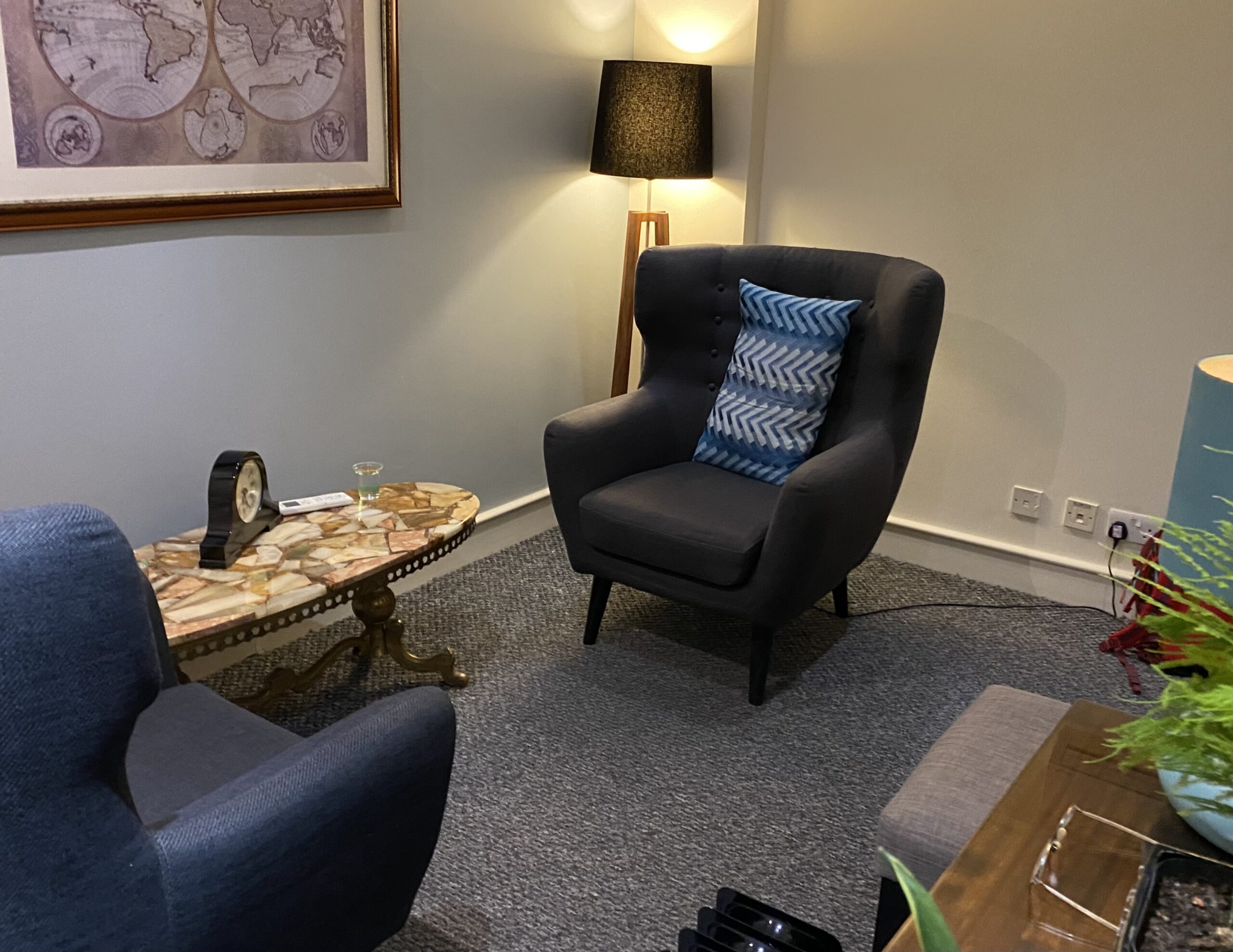
Online is not the lesser option. Some people go deeper from their own front room, and for anyone anxious about the whole idea, starting from home is a perfectly good place to begin.
£70 a session. A free fifteen-minute call first if you would rather hear a voice before deciding anything.
What to Expect
Format: Individual 50-minute sessions, weekly
Where: In person in Farringdon, London (recommended where possible), Streatham (Tuesdays, 9am - 3pm), or online for those based outside London
Starting out: A free 15-minute consultation is available first, if you’d like to ask questions before committing to a full session
Fees: £70 per session
Frequently Asked Questions
Do I need to know anything about psychosynthesis first?
No. Most people arrive knowing nothing about it and it makes no difference. And you are not really a beginner in psychology anyway - you have been studying yourself for years. What you are a beginner in is this particular relationship, and so am I. We start that part together. If you are curious about the background, what psychosynthesis is and why Assagioli left Freud covers it.
What if I do not know what to say?
Then we start there. Not knowing what to say is information, not a problem, and it is a very common way to begin.
Is it religious?
No. Psychosynthesis takes meaning and spirit seriously as parts of ordinary human experience, but it asks you to sign up to nothing, and plenty of my clients have no spiritual life at all.
Will you make me talk about my childhood?
I will not make you talk about anything. Early life usually turns up eventually, because that is often where something began. But psychosynthesis is less about excavating the past than making sense of it in the present. Yalom put it well: the past is the servant, not the master. We go back when going back lights something up here, not as a matter of routine, and always at your pace: in your own time, when you feel ready and not before.
Can I stop?
Yes, at any time. I would ask for one session to finish properly rather than ending by text, because how something ends matters. But it is your decision and it always was.

Alex Golding
BACP-Registered Psychosynthesis Counsellor
Ready to Talk?
Ready to start, or want to ask a question first - either way, I’d be glad to hear from you.