Spiritual Bypassing: When Practice Becomes a Place to Hide
From someone who’s spent 40 years on the path myself.

If you have a serious spiritual practice, whether that is Buddhist, Christian, contemplative, yogic, twelve step, or simply your own, you already know what it can do: steady you, open you, connect you to something larger than the daily grind. But practice can also, quietly, become a place to hide. The psychotherapist John Welwood coined the term “spiritual bypassing” in 1984, and spent the next two decades working it out, most fully in Toward a Psychology of Awakening. His own definition is worth having in full: “the use of spiritual ideas and practices to shore up a shaky sense of self, or to belittle basic needs, feelings, and developmental tasks in the name of enlightenment” (The Psychology of Awakening, Tricycle, 2000). Spiritual bypassing therapy exists precisely for this pattern, working with practice rather than against it.
This isn’t a criticism of practice itself. It’s a pattern many serious practitioners eventually recognise in themselves, often with real discomfort, once they’re honest about it. I include myself in that - four decades in, I still catch myself reaching for a teaching to explain something away before I’ve let myself actually feel it. Recognising the pattern hasn’t made me a lesser practitioner; if anything, it’s deepened the practice.
You Might Not Call It That
Most people living this have never heard the term. It arrives in much more ordinary language:
- You have been meditating for years and the anxiety is still there
- You know you ought to have forgiven them by now, and you have not
- You can describe what happened to you calmly and completely, and nothing has shifted
- Your practice is going well and your relationships are not
- You feel guilty for being angry, so you work on the anger instead of feeling it
- You are the person everyone comes to, and there is nobody you go to
If any of that is familiar, this is the pattern, whatever name you give it.
It Is Not Only a Buddhist Problem
Welwood named it in a Buddhist setting because that was his setting, but the pattern belongs to no single tradition. A Christian can use forgiveness to step over legitimate anger. Someone in twelve step can use acceptance to avoid grief. A yoga practice can become a way of staying in the body and out of the history. Mindfulness, taught as a way to manage difficult feelings, can quietly become a way of managing them out of sight.
Wherever there is a framework that explains suffering, there is a way of using the framework instead of feeling the suffering. The more the framework is true, the better it works as a hiding place.
Why We Reach for the Spiritual in the First Place
Long before any of this becomes spiritual, something more ordinary usually happens.
In trying to make a life, to work, to be loved, to belong, we lose touch with what we actually need and with who we actually are. It happens in romantic relationships, at work, in peer groups, anywhere there is a price on being fully ourselves. Going with the flow, pleasing people, fitting in, all of it can be a way of belonging that costs us the ability to be real.
And it accumulates. Disappointment, rejection, disillusion, and sometimes worse than that. Some of us grow so used to putting ourselves at risk that it stops registering as risk at all.
What builds up underneath is grief. Not usually grief for a person, but grief for the loss of Self. Where there is not yet enough ego strength to hold that, we look for somewhere else to stand.
Somewhere in there, the spiritual starts to look like the way out. And it is a real way out, which is exactly what makes it work so well as an escape.
The Swing
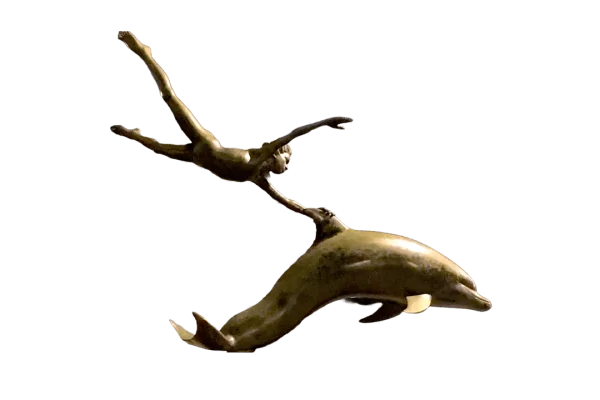
Psychosynthesis describes two different directions of growth, and they are not the same thing. Self-actualisation is horizontal: making something real in the world, in a body, in the practical business of a life. Self-realisation is vertical: the pull towards meaning, purpose and the larger Self.
The two dimensions of growth. After Vargiu (1977), as set out in Firman and Gila, Psychosynthesis: A Psychology of the Spirit, p183.
Neither is better than the other, and most of us lean one way by temperament. But when the horizontal has been painful enough, we can go almost entirely vertical and call it progress.
That is what bypassing actually is. Not simply avoiding a feeling, but leaving one whole dimension of a life for the other, and having a very good vocabulary for why.
It runs the other way too. The identity can just as easily be the disciplined body, the achievement, the person who has it all handled. I have followed both ends of that further in All Spirit, No Ground. All Ground, No Meaning.
What is really happening is that a compensation has become an identity. Something we built in order to survive a difficulty turns into who we take ourselves to be, and then it obscures the rest of us. A meditator, a Christian, a yoga teacher, a bodybuilder, a gym regular. The one who never stops working, and the one who has made a success of it. The artist. The strong one everybody leans on. The nice guy, the cool one. The list does not end, because almost anything will do the job if it works well enough.
Underneath all of them sits an idea of who we should be, or could be. We do want to strive, and there is nothing wrong with wanting that. But we also want to live in the body and the shape and the life we are in now.
And whatever the identity, the work it is doing is the same. Behind the presentable, heavily censored version of ourselves sit the feelings we decided were not acceptable: vulnerability, shame, fear, disappointment, hurt, anger. They rarely get seen or heard. Wholeness would have to include them.
Which leaves the question worth being honest about. What are we actually getting away from? Usually it is our primal wound.
What We Are Actually Working Towards
Not the removal of either extreme. Both are real, and there is something in both.
“Many spiritual seekers who suffer … from a deflated sense of self, take spiritual teachings about selflessness to mean that they should keep a lid on themselves and not let themselves shine … Since individuation involves clarifying the psychological dynamics that obscure our capacity to shine through, it is not opposed to spiritual realization. Instead, it involves becoming a more transparent vessel, an authentic person who can bring through what is beyond the person in a uniquely personal way.” - John Welwood, The Psychology of Awakening, Tricycle, 2000
I believe that, like a tree, we fare best when open to the skies while deeply rooted in the earth. Spirit and soul, and the higher Self, without denying our very human frailty.

The work is to stop being identified with either pole. To be able to live in the ordinary middle of a life, with some presence and some safety, and then to visit the heights and the depths by choice, rather than needing a peak experience in order to cut through the noise or the numbness, to feel anything at all.
It is a considerable relief when that starts to happen. Much of the exhaustion in this pattern comes from the internal fight, from the personality competing with the Self rather than serving it. When that resistance eases, the energy it was taking comes back.
That is what the diagram above is finally describing. Not a better position on either axis, but more of us available to live: wholly, congruently, and with more of ourselves brought into relationship. With the world, with other people, with nature, and with the people we are closest to, and above all with ourselves. It is both more fulfilling and more effective than the split version ever was.
And it is not selfish. To move away from the extremes of pleasing, of giving, of noble living, is not a withdrawal of care. It is honouring something in us that has been asking to be seen and heard, and choosing honesty over pretence and performance. That is self care, not selfishness.
Signs of Spiritual Bypassing
These are worth recognising early, since spiritual bypassing therapy tends to be most effective before the pattern hardens into habit:
- Reaching for a spiritual explanation (“it’s karma,” “the universe is redirecting me”) in the same breath as a painful event, before you’ve actually let yourself feel anything about it
- Using non-attachment or equanimity as a reason not to look at anger, grief, or need
- A gap between how calm or evolved you appear and how unresolved things feel underneath
- Difficulty tolerating “ordinary” negative emotions without reframing them as ego, illusion, or a lesson to transcend
- Spiritual community or identity that quietly functions as a way to avoid ordinary human relationships and their friction
- A sense that your practice has become compartmentalised - powerful in one part of life, strangely absent from the parts that actually hurt
None of this makes the practice wrong, or you a bad practitioner. It’s an extremely common pattern, and noticing it is usually the beginning of practice deepening, not evidence it’s failed.

Why It Shows Up in the Most Serious Practitioners
Ironically, the more disciplined the practice, the more sophisticated the avoidance can become. Fundamentally, the more identified we are with our higher, more noble attributes, the harder it can become to accept the lower (not lesser), more human parts of ourselves. A well-developed spiritual vocabulary gives you fluent, convincing language to describe an experience without actually having it. As Welwood himself observed, some of the students most articulate about non-attachment were, underneath, running hardest from what they actually felt. During therapy, we work to rebalance, safely allowing banished aspects of the self to gradually be accepted and integrate. We want to become whole, less split as individuals. I have worked through many aspects of this myself.
This is where psychotherapy and practice aren’t in competition - they’re complementary. Practice points toward the deeper Self, the ground beneath the personality. Therapy does the more ordinary, sometimes unglamorous work of meeting what’s actually there in the meantime: the grief, the anger, the unmet need, the parts of you practice alone hasn’t yet reached. Neither replaces the other; each reaches what the other can’t.

Why My Background Helps Here
I’ve practiced Buddhism (SGI, Nichiren tradition) for 40 years - daily practice, community leadership, the long, unglamorous work of showing up with it through very different chapters of a life. Alongside that, I trained as a psychosynthesis counsellor, a modality that, unusually among talking therapies, takes the spiritual dimension of a person seriously rather than treating it as separate from psychological health. I’m not encountering your spiritual language for the first time in the room, or translating it into clinical terms as we go. I understand, from the inside, both the real value of practice and the specific, sometimes subtle ways it can become a hiding place, because I’ve had to learn to notice it in my own. I fully understand the defences, subtle reasoning tricks and struggles that keep us stuck, obscuring genuine, fulfilling growth toward lasting self-actualisation.
This means we can talk about your practice as part of the work, not something to set aside to “do the real therapy” - while still being honest, together, about where it might be doing more avoiding than integrating.

What the Work Actually Looks Like
Not the dismantling of your practice. Mostly it is slower and more ordinary than people expect.
We start by noticing the move as it happens. There is usually a gap, sometimes only a second wide, between something landing and the explanation arriving to cover it. Learning to feel that gap is most of the work. What sits in it is often quite simple: anger, grief, fear, a need that was never met and never named.
Then we let it be there without making it mean anything yet. This is harder for practitioners than for most people, because we have years of training in relating to experience rather than being in it, and the training is good. It has to be set down deliberately.
None of this competes with practice. Once the feeling has actually been felt, the teaching that was covering it usually turns out to be true after all. It just was not doing what we were using it to do.
What to Expect
Format: Individual 50-minute sessions, weekly
Where: In person in Farringdon, London (recommended where possible), or online for those based outside London
Commitment: Weekly sessions, reviewed as we go
Fees: £70 per session
Frequently Asked Questions
Will therapy ask me to set aside my spiritual practice?
No - quite the opposite. My approach (psychosynthesis) treats the spiritual dimension as a genuine part of who you are, not something to bracket off. The aim is integration, not replacement.
What’s the difference between genuine equanimity and spiritual bypassing?
Genuine equanimity comes after fully feeling something, not instead of it. If a calm response arrives quickly and conveniently, before you’ve let yourself feel the difficulty underneath, that’s worth gently questioning.
Do I need to be Buddhist specifically for this to be relevant?
No - spiritual bypassing shows up across traditions and in secular “wellness” spirituality too. Spiritual bypassing therapy is relevant wherever a practice or belief system is serious enough to sometimes be used this way.
Is this only for people who think they’re bypassing?
Not at all - many clients come for ordinary reasons (anxiety, relationships, life transitions) and simply want a therapist who won’t be a stranger to their spiritual life or dismiss it as irrelevant.

Alex Golding
BACP-Registered Psychosynthesis Counsellor
Ready to Talk?
Ready to start, or want to ask a question first - either way, I’d be glad to hear from you.