Starting Therapy for the First Time? Why It Takes Real Courage
For anyone hovering over the “book a consultation” button, wondering if needing this means they’re weak — or not struggling enough to deserve it.

Most people who get in touch with me have been thinking about it for a while — weeks, sometimes years — before they actually send the message. Not because they don’t want to feel better. Almost always, it’s something quieter than that: a worry about what it might mean if they need help at all. Shouldn’t I be able to manage this myself? Isn’t this a bit much, for what I’m actually going through? What if I sit down and don’t know what to say?
If any of that sounds familiar, I want to say something plainly, before anything else: starting therapy for the first time isn’t a sign that something’s wrong with you. More often, it’s the opposite — it’s what happens when a part of you is ready to stop managing alone.
“Owning our story and loving ourselves through that process is the bravest thing that we’ll ever do.”— Brené Brown
Why Starting Therapy Feels So Hard
In psychosynthesis, we talk about the survival personality — the collection of strategies each of us built, often very young, to stay safe and stay loved. For a lot of people, one of those strategies was simple: cope quietly, don’t make a fuss, handle it yourself. It probably worked, for a long time. That’s exactly why it’s still running.
So when the idea of starting therapy for the first time comes up, it isn’t really competing with logic — you likely already know, logically, that talking to someone could help. It’s competing with an old, deeply loyal part of you that equates coping alone with being safe. That part isn’t wrong to be cautious. It’s just operating on information that’s out of date.
What Therapy Actually Is — And What It Isn’t
A few things I hear often, from people right before they start:
“Therapy is only for people with serious problems.”
Some of my clients are navigating something acute. Many more are navigating something quieter — a relationship pattern they keep repeating, a low hum of anxiety, a sense that they’re succeeding on paper but not quite feeling it. You don’t need a crisis to deserve support.
“I should be able to handle this myself.”
You’d see a doctor for a physical injury without a second thought. Emotional weight deserves the same basic care, not more scrutiny.
“Talking about it won’t actually change anything.”
Therapy isn’t just talking for its own sake. It’s building genuine insight into your own patterns, and developing the tools to actually do something different with them.
“A therapist will just tell me what to do.”
I won’t. My work is to help you find your own answers — not hand you mine.
What Real Strength Actually Looks Like

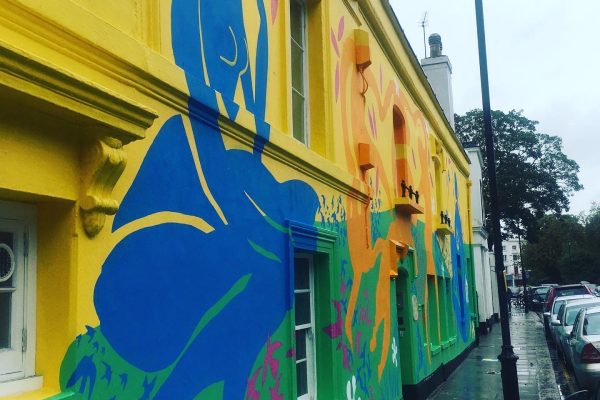
Holborn mural – hope and compassion
Real strength isn’t holding everything together on your own. It’s being willing to be seen — uncertainty, mess, and all — by another person, and letting that be enough of a starting point.
“We cannot change, we cannot move away from what we are, until we thoroughly accept what we are. Then change seems to come about almost unnoticed.”— Carl Rogers, On Becoming a Person
Starting therapy for the first time tends to open up more than just the specific issue that brought you there. Clients often tell me it improves their relationships, their work, their sense of who they actually are underneath the coping. Not because therapy fixes everything, but because the energy once spent holding it all together becomes available for actually living.
What Starting Therapy With Me Actually Looks Like
I work as a BACP-registered psychosynthesis counsellor, which means I’m not just interested in managing your symptoms — I’m interested in the whole of who you are: your history, your relationships, your sense of meaning, and yes, your spiritual or creative life too, if that’s part of you. Alongside my clinical training, I bring 40 years of Buddhist practice and a background in the arts — not as a technique, but as a genuine way of listening.
Your first session isn’t a test, and there’s no script you’re supposed to already have. We start wherever you actually are — uncertain, guarded, relieved, all of it — and build from there, at your pace. If you’re not sure whether it’s the right fit yet, a free 15-minute consultation exists precisely for that: no pressure, no obligation, just a conversation to see how it feels.
What to Expect
Format: Individual 50-minute sessions, weekly
Where: In person in Farringdon, London (recommended where possible), or online for those based outside London
Starting out: A free 15-minute consultation is available first, if you’d like to ask questions before committing to a full session
Fees: £70 per session
Frequently Asked Questions
Is therapy only for people with serious mental health problems?
No. Most of the people I work with aren’t in crisis — they’re navigating stress, transitions, relationship patterns, low self-esteem, or a quiet sense that something isn’t quite right. Therapy is for growth as much as it’s for crisis.
What if I don’t know what to say in my first session?
You don’t need to arrive with a script, or even a clear problem. Starting therapy for the first time often just means starting a conversation — I’ll help guide it. Not knowing where to start is a completely normal, welcome place to begin.
Is starting therapy for the first time confidential?
Yes, subject to standard legal and ethical exceptions (such as risk to yourself or others), which I’ll explain clearly at the outset. No one needs to know you’re in therapy unless you choose to tell them.
What if I try it and it’s not for me?
That’s genuinely alright. A free 15-minute consultation exists precisely so you can get a feel for whether it’s right before committing to anything further — no pressure, no obligation.

Alex Golding
BACP-Registered Psychosynthesis Counsellor
Ready to Talk?
Ready to start, or want to ask a question first — either way, I’d be glad to hear from you.