Conscious Kindness: A Compassionate Response to the Harsh Inner Critic
A four-stage framework for understanding your harsh inner critic - and finding your way to something kinder.

“We cannot change, we cannot move away from what we are, until we thoroughly accept what we are. Then change seems to come about almost unnoticed.” - Carl Rogers, On Becoming a Person
There is a voice that follows many people throughout their lives - the harsh inner critic. Sometimes it appears as self-doubt; we tell ourselves that we are not enough, or too much. Other times as perfectionism or trying to match ideal versions of ourselves, often in the form of ‘shoulds’. Sometimes as anxiety, shame or a relentless pressure to prove ourselves. Perhaps you have heard this voice quietly, or loudly - even incessantly - commenting on your every move; your mistakes, shortfalls, constantly comparing with others.
When this becomes so familiar that we no longer recognise it as a voice at all, it simply feels like reality. In psychotherapy, this voice is often described as the harsh inner critic. It sits behind many of the difficulties that bring people into therapy, governing low self-esteem, people-pleasing, perfectionism, burnout, depression, and relationship difficulties - a persistent feeling of never quite being enough. Yet despite its prevalence, this harsh inner critic is rarely the real problem. More often, it is a symptom of something deeper.
People sometimes assume the goal of therapy is to get rid of the critic altogether. In my experience, this is neither realistic nor particularly helpful. Our inner critic developed for a very good reason - it helped us stay safe, avoid rejection, gain approval or maintain important relationships in early life. The difficulty arises when strategies that once worked to protect us continue operating long after their original need has passed.
Psychosynthesis therapy with me offers a compassionate way of understanding and working through this. Rather than seeing the critic as an enemy, psychosynthesis views it as one aspect of a wider survival personality: a collection of adaptations that developed to help us navigate our early world.
“Survival personality is fundamentally a broken empathy with ourselves, a truncation of our authentic experience of ourselves, the world, and the Divine.” - Firman & Gila, Psychosynthesis - A Psychology of the Spirit
These adaptations may once have been necessary. However, as adults they can become restrictive, limiting our spontaneity, authenticity and capacity for genuine connection. Healing therefore becomes less about fighting parts of ourselves and more about understanding them. This article explores what I call Conscious Kindness, a framework inspired by the Four Stages of Competence model, describing how we move from unconsciously criticising ourselves towards a more compassionate, integrated and authentic way of living.
The Four Stages of Competence and Emotional Growth
The original Four Stages of Competence model was developed to explain how people learn new skills. At first we do not know what we do not know. Then we become aware of our limitations. With practice we improve, and eventually the skill becomes second nature.
I have observed a similar process occurring through the journey of therapy, particularly in the way we relate to ourselves. The journey of conscious kindness follows four stages: Unconscious Unkindness, Conscious Unkindness, Conscious Kindness and Unconscious Kindness. The journey is rarely linear - most of us move backwards and forwards between these stages throughout life. Nevertheless, this framework provides a useful map of what healing often involves.
Stage One: Unconscious Unkindness
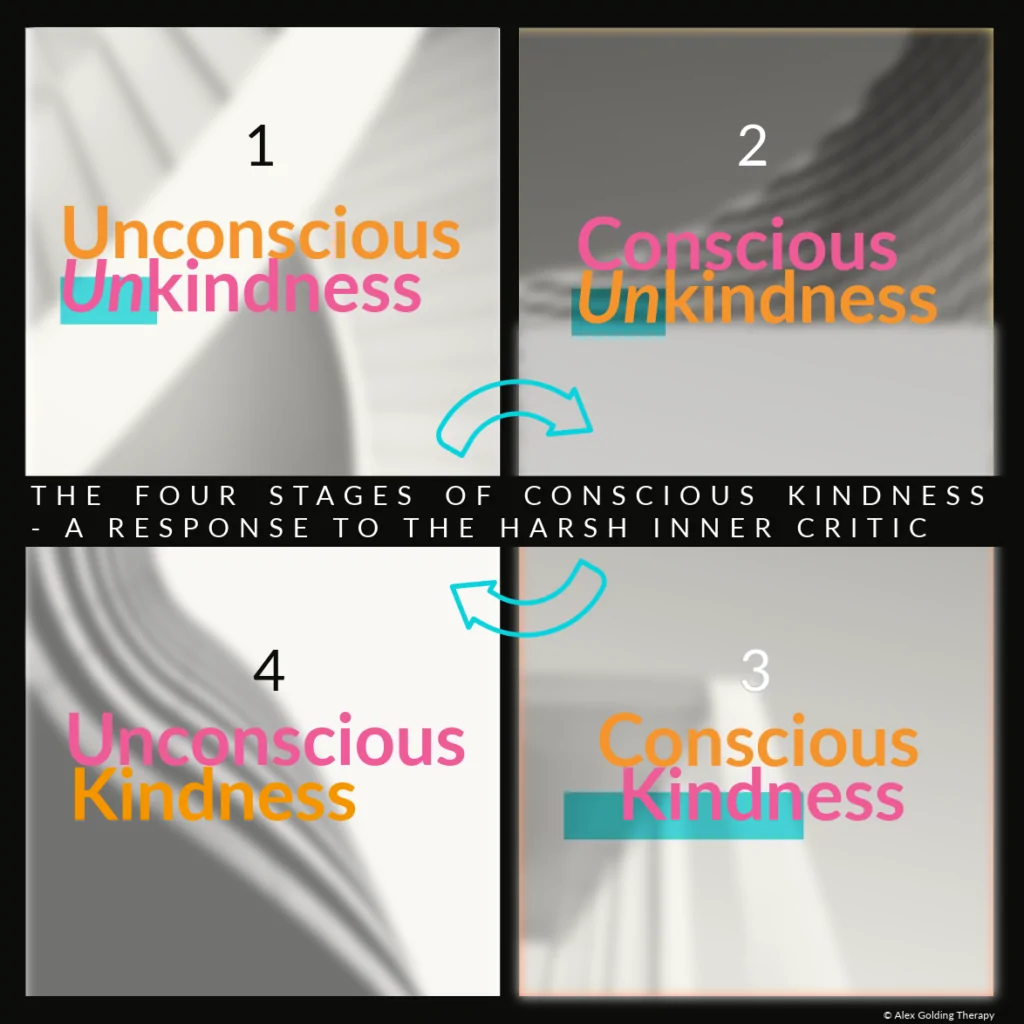
Many clients come to therapy simply because they want to feel better. At that point they may not realise that they have a very harsh inner critic - what CBT calls automatic thoughts.
One of the most striking features of the harsh inner critic is how invisible it can become. We have lived with it so long that we assume its voice is speaking the truth. Thoughts such as “you’ll never be successful” or “you always mess things up” become so familiar that they no longer feel like opinions. They feel like truth.
In psychotherapy, such messages are often called introjects - beliefs absorbed from the outside world and taken inside as though they belong to us. Parents, teachers, peers, cultural expectations and wider society all contribute. Over time, external voices become internal voices, and the critic thrives upon remaining unquestioned. One important question when statements come up in therapy is simply: whose voice is this speaking? Closely followed by another: is it actually true?
Stage Two: Hearing the Harsh Inner Critic
If Unconscious Unkindness is characterised by believing the critic, Conscious Unkindness begins when we hear it. This can be an uncomfortable stage - before, the voice operated in the background; now it becomes harder to ignore. But it is illuminating too. You might notice how often you dismiss compliments, minimise achievements, or speak to yourself in ways you would never dream of speaking to somebody you love.
Awareness is often the beginning of change. We cannot change what remains unconscious. Many clients experience this stage as a gradual awakening, noticing patterns that have shaped their lives for years - the perfectionism that once appeared responsible now looks exhausting; the people-pleasing that once seemed caring starts to feel costly.
The Search for Validation
One of the most common consequences of a harsh inner critic is the belief that our worth depends upon external validation. If we achieve enough, perhaps we will finally feel enough. Yet it rarely works that way - the goalposts move, the standards change, the critic quickly finds something else that requires improvement.
Carl Rogers stressed the importance of developing an ‘internal locus of evaluation’ to regain our agency, by rebalancing our reliance upon external approval - learning to trust our own experience rather than constantly looking outside ourselves for confirmation that we are acceptable. What he described was a gradual move away from facades and from living by other people’s oughts, towards something more real, where our own feelings come to be valued rather than overruled.
But change is easier said than done. If our sense of worth has been built upon approval or achievement, stepping away from those sources can feel frightening, even irresponsible. Yet without this shift, life can become an endless attempt to satisfy expectations that never truly belong to us. Therapy often begins helping people ask a different question: who am I when I stop trying to prove myself?

People-Pleasing and the Fear of Disappointment
People-pleasing is frequently misunderstood. From the outside it may appear generous or considerate. However, beneath chronic people-pleasing there is often anxiety, or a need for control - the anxiety of disappointing others, the fear of rejection, or the emptiness of no longer being needed.
A person may become highly skilled at recognising everybody else’s needs while losing touch with their own, struggling to set boundaries or fear saying no. Ironically, the very strategy designed to preserve connection can eventually undermine it - relationships become based upon adaptation rather than authenticity. Learning how to become more authentic in relationships is something I often work with; therapy is often a practice in addressing this both safely and relationally.
“People have two basic needs: attachment and authenticity. When authenticity threatens attachment…attachment trumps authenticity.” - Gabor Maté, The Myth of Normal
The False Self and the Cost of Adaptation
British psychoanalyst Donald Winnicott described what he called the False Self: the ways we learn to adapt to the expectations of others, often at the cost of losing touch with our own spontaneity and vitality. This False Self is not necessarily dramatic - it can look highly successful, accomplished and admired - yet beneath the surface there is often a sense of emptiness or fatigue.
“The False Self has three functions: …it attends, within severe limitations, to the mother; it hides and protects the True Self by complying with environmental demands, and it is also a ‘caretaker’…taking over the function of the environment that has failed. It is a primitive form of self-sufficiency in the absence of nurture.” - Adam Phillips, Winnicott, pp.133-134
Many of us choose attachment over authenticity, because attachment is essential for survival. As children, this choice is understandable. As adults, continuing to sacrifice authenticity comes at a considerable cost. Psychosynthesis frequently involves rediscovering, and ultimately synthesising, the parts of ourselves that were pushed into the background long ago.
“We can take the theory of compensation as a basic law of psychic behaviour. Too little on one side results in too much on the other. Similarly, the relation between conscious and unconscious is compensatory.” - Jung, 1931, cited in Storr, The Essential Jung, p181
Jung, Compensation and the Parts We Leave Behind

Carl Jung recognised that human beings are rarely as simple as they appear. He observed that many of our patterns are compensatory: if vulnerability feels unsafe, we may become fiercely self-reliant; if uncertainty feels threatening, we may seek control. The harsh inner critic often develops within this system, attempting to keep life organised, predictable and safe - yet in doing so, other qualities can gradually recede into the background.
Creativity, playfulness, tenderness and joy do not disappear; they simply become less available. Part of psychological healing involves inviting these qualities back into awareness, not because they are more important than the critic, but because a healthy personality requires balance.
The Cultural Critic: The Voice in Context

Early relationships and personal experiences matter deeply, but they are only part of the story. Our harsh inner critic did not develop in isolation. We are social beings shaped by the wider culture in which we live - the messages we receive about success, strength and belonging gradually become internal standards we measure ourselves against.
From a wider perspective, we are shaped not only by our personal history but also by collective and cultural forces - race, gender, economics, and our need to belong all influence how we experience ourselves. As a therapist, I take context into account when considering clients’ presenting issues, with regard to race, gender, sexuality or any difference. Modern Western society often rewards individual achievement and measurable success at the expense of connection or community; social media amplifies these pressures further.
Once we begin recognising these influences, we can respond differently by deciding which voices genuinely deserve our attention. This marks the beginning of the next stage: Conscious Kindness.
Stage Three: Responding With Conscious Kindness
Conscious Kindness begins with responding differently - not by pretending everything is fine, or replacing every critical thought with positive affirmations, but by accentuating genuine self-compassion. This allows us to acknowledge our struggles without reducing ourselves to them, and to recognise mistakes without berating ourselves for personal failure.
We might begin noticing that familiar voice and gently question it: is what I’m hearing actually true? Is it helpful? Does it belong to the present moment, or to an earlier chapter in life? Importantly, Conscious Kindness does not attack the harsh inner critic - it seeks to understand it. One of the most transformative questions we can ask is: what is this part trying to do for me? Its methods may be harsh. Yet its original intention was often protective.
From Survival to Self

Psychosynthesis offers a profoundly hopeful understanding of psychological growth. Roberto Assagioli recognised that human beings are made up of many different parts, drives and subpersonalities. We are not a single, fixed identity. One damning aspect of the harsh inner critic is the shaming sense it gives that we are damaged or fundamentally wrong at the core - but the critic is one such part among many. So too is the people-pleaser, the achiever, the caretaker, the creative dreamer, the wise observer.
When we are identified with the critic, its voice becomes reality; but when we begin observing it, space emerges. We discover other parts of ourselves - anger, pain, resentment, but also compassion, creativity, tenderness - have been waiting patiently in the background. Therapy therefore becomes less about removing parts and more about creating a healthier relationship between them.
The goal is not perfection. The goal is integration.
“…this journey from survival to authenticity is not one we finally complete, finding ourselves eventually in a state of blissful perfection. Authenticity is not an enlightened state to be grasped, but a direction in which to face.” - John Firman and Ann Russell, Opening to the Inner Child: Recovering Authentic Personality, p40
As John Firman and Ann Gila observed in their psychosynthesis writings, much suffering stems from disconnection from ourselves. Healing involves restoring relationship with those neglected aspects of our humanity that had to be hidden, rejected or sacrificed in order to belong.
From Potential to Manifestation - Being Rather Than Constantly Doing
Many people come to therapy exhausted - not because they are lazy, but quite the opposite. They have spent years trying harder, achieving more, holding everything together at significant cost. We learnt to value ourselves for what we accomplish rather than who we are, and the harsh inner critic thrives within this environment.
Thomas Moore, in his book Care of the Soul, writes that the soul asks for depth rather than speed. When we begin cultivating self-compassion, we often discover something surprising: we become more productive, not less; more creative, more resilient. Our energy previously consumed by self-criticism becomes more available for living.
“We are both Being and Becoming in the same breath.” - Diana Whitmore, Psychosynthesis Counselling in Action
I like this quote because it speaks to the soul’s journey in each moment - the acknowledgement and integration of who we are, even if that feels unsure or incomplete. There is permission, compassion, acceptance. And in my view, it is acceptance that leads to change. So growth and acceptance are not opposites; the healthiest forms of growth often emerge from self-acceptance.
The Courage to Be Vulnerable
For many people, Conscious Kindness involves developing a different relationship with vulnerability. Our culture often rewards strength, certainty and control, frequently along rigid and limiting lines - whether because of gender expectations, neurodiversity, disability, ethnicity or sexuality, many people learn to hide aspects of themselves that feel tender or different.
Brené Brown’s work stresses that vulnerability is not weakness; it is the birthplace of connection, courage and authenticity. Many clients initially fear that becoming kinder to themselves will make them complacent. But by risking a deeper level of self-trust, they discover the opposite: self-compassion creates the safety required for honesty.

Stage Four: Living Beyond the Harsh Inner Critic
This final stage is not perfection, nor the absence of struggle. Life remains uncertain; difficult emotions still arise. The difference is that compassion and inner flow become more natural. The harsh critic may still speak from time to time, but it no longer dominates the conversation - it becomes one voice among many rather than the voice that defines us.
It is often here that people begin experiencing greater joy, abundance and connection, living from values that genuinely reflect who they are. Psychosynthesis describes this as a journey towards self-realisation. I often think of it more simply: it is the journey of learning to live the life you live - not the life you think you should live, or somebody else expects. Your life. More consciously, more authentically, and more compassionately.
As we become more accepting of ourselves, relationships can become deeper and more genuine, because we are no longer hiding so much of who we are. This is not always comfortable - when we risk being more ourselves, some people may prefer the old version of us they knew. Yet the cost of abandoning ourselves is usually greater.
“We cannot change anything unless we accept it. Condemnation does not liberate; it oppresses.” - Carl Jung, Modern Man in Search of a Soul
Psychosynthesis teaches that healing is not about becoming somebody else. It is about becoming more fully ourselves. Over time, the harsh inner critic becomes quieter, not because it has been defeated, but because it no longer needs to run our lives. Beneath its voice there has always been another voice waiting patiently to be heard - a wiser, kinder voice. Perhaps, with time, the quiet recognition that what we have been seeking was never perfection, but permission to become more fully who we already are.
What to Expect
Format: Individual 50-minute sessions, weekly
Where: In person in Farringdon, London (recommended where possible), or online for those based outside London
Commitment: This kind of work tends to unfold gradually - most clients notice a shift within the first several sessions, with deeper pattern-work continuing beyond that
Fees: £70 per session
Frequently Asked Questions
What exactly is the harsh inner critic?
A persistent inner voice that judges, compares, and finds you wanting - often so familiar it no longer feels like a voice at all, just reality. In psychotherapy it’s understood as one part of the personality, not the whole of who you are.
Is Conscious Kindness just positive thinking or affirmations?
No - it’s not about replacing critical thoughts with forced positivity. It’s a four-stage framework for genuinely understanding and relating differently to the harsh inner critic, rooted in awareness rather than denial.
Can therapy really change a harsh inner critic that’s been there for years?
Yes, though it’s gradual rather than instant. Most clients move back and forth through the stages rather than progressing in a straight line, and the critic becomes quieter and less dominant over time rather than disappearing entirely.
Does this only apply to low self-esteem, or is it broader than that?
Much broader. The harsh inner critic shows up in perfectionism, people-pleasing, burnout, difficulty with vulnerability, and relationship patterns - not just low self-esteem in an obvious sense.

Alex Golding
BACP-Registered Psychosynthesis Counsellor
There is a guided practice on the site that works with this voice directly: a disidentification practice, in two lengths, with the full transcript.
Ready to Talk?
Ready to start, or want to ask a question first - either way, I’d be glad to hear from you.