The World Beyond Your Skin
On impact, inequality and inheritance, and why naming what came from outside changes what can be done with it.
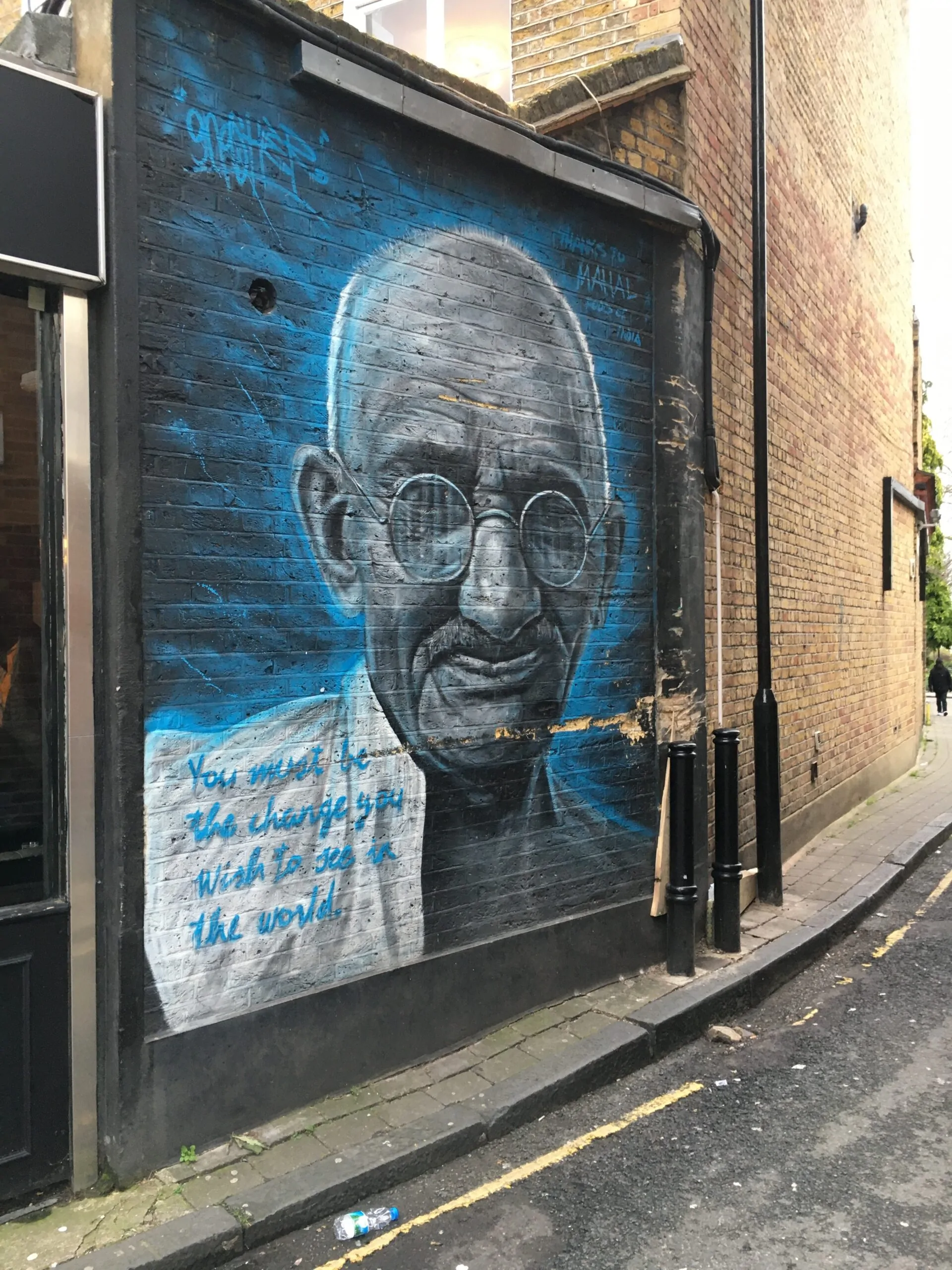
“No human being is free from the strain of relating inner and outer reality.” - D. W. Winnicott, Playing and Reality, p18
Somewhere along the way we absorb the idea that our difficulties are privately manufactured and privately to be fixed. That if we are anxious, we are an anxious sort of person. That if we are angry, we should not be. That if the mornings are hard there is something the matter with our character. That everyone else appears to be managing.
Nobody teaches this directly. It arrives anyway, and most of us are carrying the verdict long before we notice we have reached it. The problem is us.
The verdict came from outside. It was issued by the same world that supplied the conditions, measured against standards that world set, and handed over as though it were a discovery we had made about ourselves.
I came to this work late, after a long time doing something else. I lived under that verdict for years before I had language for it, and longer still before it occurred to me that the question was badly put.
Impact
Impact is a physical word before it is a psychological one. The dictionary gives it as collision, strong effect, influence, and the ability of a material to resist breaking when struck. All four are at work in a life. Something arrives, it carries force, it leaves a mark, and something in us either holds or gives way.
Trauma, understood this way, is not the event. It is our response to an impact that overwhelmed the capacity available to meet it. The same collision at thirty-five with support behind you might leave little. At seven, alone, it organises a life.
Winnicott describes experiences
“that went beyond her capacity to allow for, and were therefore traumatic, necessitating the organisation of new sets of defences.” - D. W. Winnicott, Playing and Reality, p28
Then defences are organised, because something had to be. A child works out at six or seven which version of themselves is safest, and builds it. The funny one. The easy one. The one who never needs anything. Thirty years on this is described as a personality, and usually as a fault. It was a solution, reached under real conditions, by someone with no other options available.

A great deal of what is later brought to therapy as a fault is one of those arrangements, still in place long after the conditions that required it have gone.
Which changes the question. Not what is wrong with me, but what struck, how hard, and what was there to absorb it.
We are porous beings
The impacts that shape a person are not confined to the house they grew up in.
James Hillman: “we are parented by everything around us.” We are “ecological from day one”, and “the more I believe my nature comes from my parents, the less I am open to the ruling influences around me.”
So the field includes the school and what it decided you were. The street. Money, or its absence, working on a childhood for fifteen years without once being named. An accent that opens or closes a door before a word is spoken. The century you landed in and what it was doing while you formed.
Assagioli, who founded psychosynthesis, put it in a line: “a person is always in a social context; he is not an isolated unit.” He was specific about what that context does. The “intricate economic and social machinery” a person is enmeshed in makes “ever more insistent demands on his energy, his mental functions, his emotions, and his will.”
Francis Weller locates it in the body rather than the head. We are not isolated cells but have “semi-permeable membranes that make possible an ongoing exchange with the great body of life”. So “the personal and the planetary are inseparable”.

We are porous beings. What is outside comes in.
Four hundred years ago, sick in bed and listening to a bell rung for somebody else, John Donne said it.
“No man is an island entire of itself… every man is a piece of the continent, a part of the main.” - John Donne, Devotions upon Emergent Occasions, Meditation XVII
The Buddhist sage Nichiren wrote:
“If their minds are pure, so is their land. There are not two lands, pure or impure… The difference lies solely in the good or evil of our minds.” - Nichiren, The Writings of Nichiren Daishonin, vol 1, p4
Both speak to the porous nature of human existence. We are changed through contact, in an ever unfolding, symbiotic relationship with our environment. And no counselling space is an island either, devoid of the impure land. We are all “involved in mankind”, inseparable from it.
None of which is mystical. Twin studies establish that genetic effects are modified by environmental ones. What is inherited is not a script. It is a set of tendencies meeting a world.
I spent thirty years running youth, men’s and community groups before I trained. A strange apprenticeship for this work and a valuable one, because you are not meeting people singly after something has gone wrong. You are watching the conditions do it, across many lives at once. The same pressure entering twenty lives and coming out twenty different ways, and to each of them it looked like a private flaw.
And still, a great deal of therapy proceeds as though the person arrived alone.
What gets called normal
R. D. Laing: “what we call ‘normal’ is a product of repression, denial, splitting, projection, introjection and other forms of destructive experience.”
He was not being provocative. The standard we measure ourselves against did not fall out of the sky. It was assembled by particular people under particular conditions, and it carries their assumptions, blind spots and interests inside it. The measuring is where much of the damage is done. Not the difficulty so much as the verdict we reach about ourselves for having it.
David Smail said the practical version after a career of looking. What caused people distress was “not so much their own mistakes, inadequacies and illnesses as the powers and influences that bore down upon them from the world beyond their skin.”
Powers and influences. Not feelings about powers and influences.
So the question the rest of this is trying to answer. How can a person be met in the consulting room if their experience and what informed it are left outside, or dismissed because the therapist has never had to think about it?
Not everyone is impacted equally
This is where the argument has to get specific, because “we are all shaped by our surroundings” is a comfortable sentence that costs nothing.
Two people can walk down the same street and be in two different countries. What happens there depends on skin, name, accent, gender, body, whether the steps can be climbed, and how much money is standing behind you. That is not a difference in perception. It is a difference in what is done to you and what is available to you.
Patriarchy issues instructions before birth about what a woman is for and what a man is permitted to feel. Racism is not only an insult, it is a housing decision, a hiring decision, a diagnosis and a sentence. Disability is largely manufactured by buildings and timetables designed by people who assumed a particular body. Class arrives as an accent and stays as a ceiling. Where you were born determines more of what your life will contain than anything you will ever decide about yourself.
None of this is background. It is impact, delivered daily, and the fact that it is delivered to millions does not make it lighter on the one person carrying it.
Maslow’s hierarchy makes the same point from underneath. Physiological needs form the base, and safety, belonging and love are built on it. Self-actualisation and transcendence come second to the existential ones, because that is the order in which behaviour is actually driven. As he put it, “no need or drive can be treated as if it were isolated or discrete; every drive is related to the state of satisfaction or dissatisfaction of other drives.” Which is a plain way of saying that a person who cannot make rent is not failing at self-actualisation. Poverty is not a mood, and insecure housing is not a mindset.
Anger, in that light, is often accurate.
The same holds for the world itself. People are grieving weather, species, coastlines and futures, and finding there is nowhere to put it. If the personal and the planetary are inseparable, then what is happening to the planet is happening to people, and it arrives as dread or numbness that gets treated as a private problem with mood.
Shame loses some of its grip when we can see what it is attached to: race, gender, neurodiversity, money, education, class. What we had filed as our own fault turns out to have been arriving from somewhere, and to have arrived for other people too.

What gets handed down
Tolstoy opens Anna Karenina with “all happy families are alike; each unhappy family is unhappy in its own way.” The particulars differ. The machinery is more alike than it looks.
Franz Ruppert argues that traumatised societies operate in trauma-survival mode most of the time, transmitting down the generations through repeating cycles of war, poverty, violence, displacement and abuse.
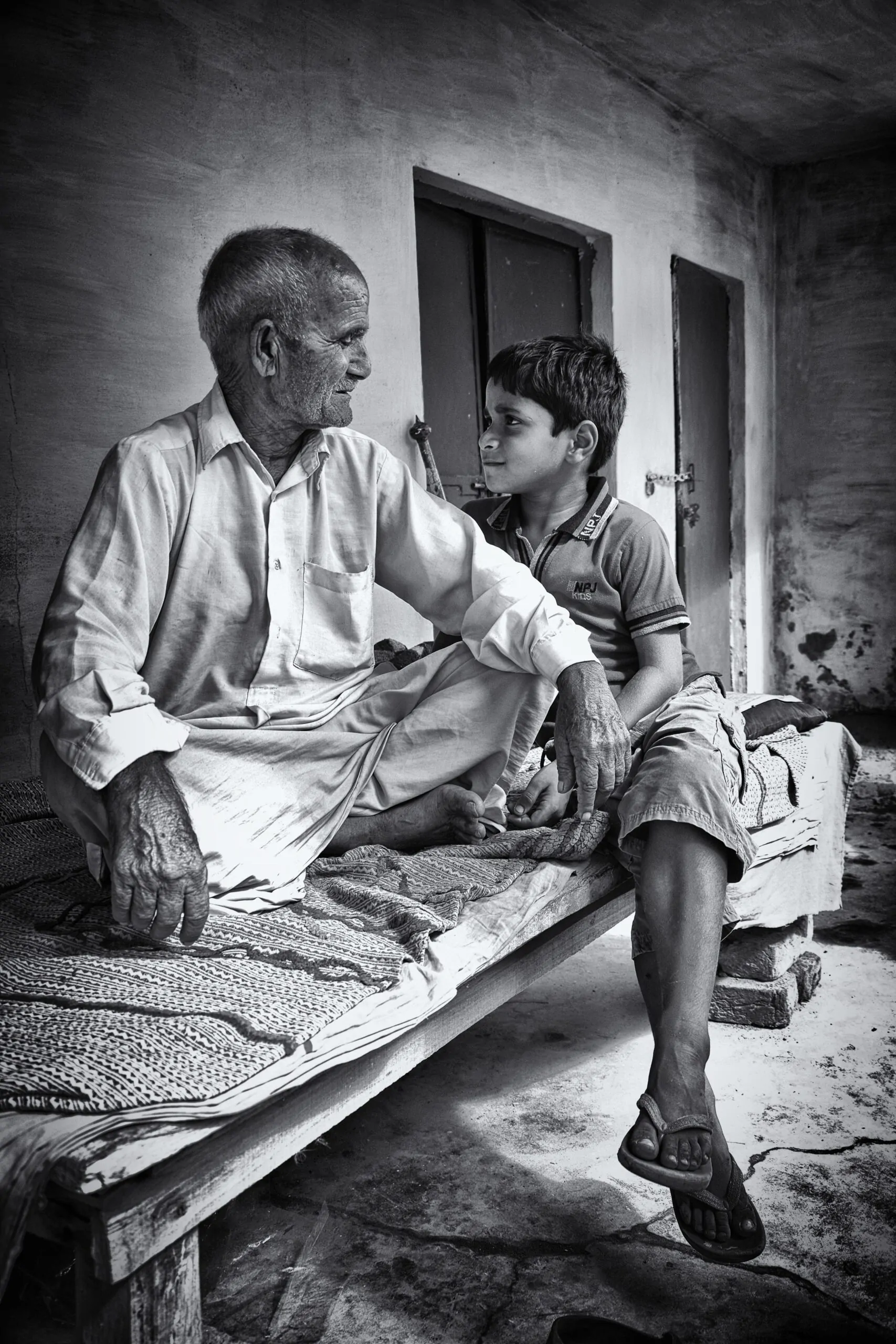
Most people know a version of this without having words for it. A grandparent who never spoke about something, and a family that learned not to ask. A way of bracing that everyone in the house had and nobody remembered learning.
Family systems thinking names the machinery. A family is a system, and a system distributes its difficulty. One member tends to carry the symptom on behalf of the whole, without knowing that is what they are doing, and is then treated, by everyone including themselves, as the one with the problem.
That is the subtle part, and it is the reason this matters in a consulting room. We are shaped to experience as individual something that was never only ours.
Jung put a wider frame around it again. Beneath personal history he placed the collective unconscious, and in it the archetypes: patterns of human experience that nobody invents and everybody lives through. The Orphan. The Warrior. The Mother. The Exile. People arrive in therapy inside one of these without a name for it, and finding the name changes the temperature, because the shape turns out to be old and shared rather than a personal invention.
Then a caution, because there are a great many forces in this argument and a person in difficulty does not need a lecture on all of them. Naming one accurately is worth more than naming five.
And we impact back
So far this has run one way, and that is only half of it.
If we are porous, the traffic goes both ways. Weller’s membrane is an exchange, not a delivery. And Nichiren’s line is not that the land shapes the mind, it is the reverse. If their minds are pure, so is their land. What changes in a person changes what is around them.
We are impacted by our surroundings and we impact our surroundings. We feed the collective as surely as it feeds us. No individual struggle is conducted in isolation, and nothing resolved in one life stays inside that life. Which is less comforting than it sounds, because it means our own work is not a private matter either.
This is where psychosynthesis takes something more seriously than most approaches: the will.
Not willpower, which is clenching and runs out. The capacity to know what you want and move toward it. Assagioli treated the will as a faculty to be developed rather than a virtue you either possess or lack. Impact is not the end of it. What we do with it is the rest.
Forty years of putting Buddhist humanism into action is the ground I bring to that, and in practice it amounts to a willingness to stay with something difficult rather than move it along.
An argument like this one curdles if it is left standing on its own, and it curdles in two directions.
The first hands everything over. If it is all history, economics, inheritance and power, then nothing is mine and there is nothing to be done. That is not liberation but a more sophisticated paralysis, and it makes a victim of someone who is not one.
The second turns therapy into politics with a practitioner attached. Nobody comes for that and I am not offering it. The world is already in the room, named or not. That is the whole of the claim.
So the sorting is the work. What is mine, and what belongs to someone else. Not in order to allocate blame, but because the two are handled differently. What was done to me I can name, grieve, and stop carrying as evidence about myself. What is mine I can change. Getting that line in the right place is most of the job, and most of us have it in the wrong place, usually in both directions at once.
The conditions were not of your making, and you are the one who has to live from here. Context explains. It does not absolve, and it will not act on your behalf.
The other person in the room is also impacted
The second half of that earlier question is the harder one, because it is about me.
It would be convenient if the therapist were a neutral instrument. We are not. I arrive with my own inheritance and my own assumptions about what people are like and what a difficulty means. They turn up before the person does, and the ones I have not caught are the ones doing harm.
What I bring is also what allows the work. I hear you because I hear myself. Without having been impacted I am not sure I could be much use. I have sat in the other chair as well, which is where I learned the difference between being sympathised with and being met accurately. The second is worth considerably more and is less comfortable to receive.
What is needed is not a neutral space. It is a room willing to be impacted. A brave one.
Who is not in the room
Judging how far the world reaches into the clinical space means asking what the counselling space actually is. Where does it exist, and for which people? Who is operating within it? What unconscious assumptions do they carry about each other? And what power relationship exists between them?
It has a fee, an address, a waiting time, a language it conducts itself in, and a set of assumptions about health that came from somewhere. Pretending otherwise does not make it neutral. It makes it unexamined.
And the external impact on one counselling space is not the external impact on another. A makeshift tent in a Rohingya refugee camp in Bangladesh. A bunker in a war-torn Ukrainian village. My room in Farringdon, with two armchairs and a box of tissues. For many of us peace is an inner question, because the outward kind came with the country we were born in. For many others it is not available in either form.
Then the harder count. There are countless victims of intersectional violence, discrimination and bias who will never find their way into a counselling space at all, for ecological, economic and global reasons, cultural as well as material.
So the meaningful question about how far these things reach may not be about the people in the room.
Who is not in the counselling space, and why?
What this looks like in practice
Less dramatic than it sounds.
It means asking about what other rooms treat as outside the remit. Money. Where you live and whether you can stay. What your work does to you, as distinct from what you do there. Whether people like you are treated a particular way, and whether you have ever said so out loud without it costing you. What was happening in your family before you arrived in it.
It means naming the obvious thing when the obvious thing is not being said. If race is in the room it is better named than tiptoed around. If money is why someone cannot do what they say they want to do, that is worth more than another examination of their motivation.
It means refusing to reduce anyone to their presenting symptoms. Psychosynthesis begins from the position that a person is a fundamentally healthy organism in which there may be a temporary malfunctioning. Not a fault requiring correction. Someone whose difficulty is doing something, and usually something that made sense once.
And it means holding two focuses at once. What is happening, and what is trying to happen. Diana Whitmore distinguishes change that rearranges the contents of a life from change that alters the system those contents sit in, and calls the second “the only real change”. There is no reaching it without the context, because the context is most of the system.
What is worth taking from this
None of this says your difficulties are unreal, or that they belong to someone else to solve.
It is narrower and more useful. Much of what people bring to therapy as proof of their own inadequacy turns out, examined, to be a proportionate response to an impact. Not all of it. Enough to be worth establishing before concluding otherwise.
A person carrying a burden they believe to be a personal defect cannot put it down. A person who can see it accurately sometimes can. And what they do next is not only theirs, because the traffic runs both ways, always.
You are not an isolated unit. You never were.


Alex Golding is a psychosynthesis counsellor working in Farringdon and Streatham, and online. He came to the work after thirty years running youth, men’s and community groups. Registered member of the BACP, no. 411804.
Sources
Assagioli, R. (2007) The Act of Will, Synthesis Center Press, p3 (originally published 1973) · Assagioli, R., interviewed by Sam Keen, “The Golden Mean of Roberto Assagioli”, Psychology Today, December 1974 · The Concise Oxford Dictionary (1982), definition of impact · Donne, J. (1624) Devotions upon Emergent Occasions, Meditation XVII · Hillman, J. (1997) The Soul’s Code, p86-87 · Laing, R.D. (1990) The Politics of Experience, p10 · Maslow, A. (1943) “A Theory of Human Motivation”, Psychological Review · Nichiren, The Writings of Nichiren Daishonin, vol 1, p4 · Ruppert, F. (2019) Who Am I in a Traumatised and Traumatising Society, Green Balloon Publishing, p136-137 · Smail, D. (1996), p10, cited in Zaheed, N. and Cooke, R. (2023) Therapists Challenging Racism and Oppression, p45 · Tolstoy, L. (1877) Anna Karenina, opening line · Weller, F. (2015) The Wild Edge of Sorrow, p xvi-xvii · Whitmore, D. (2000) Psychosynthesis Counselling in Action, p22 · Winnicott, D.W. (1971) Playing and Reality, p18 and p28
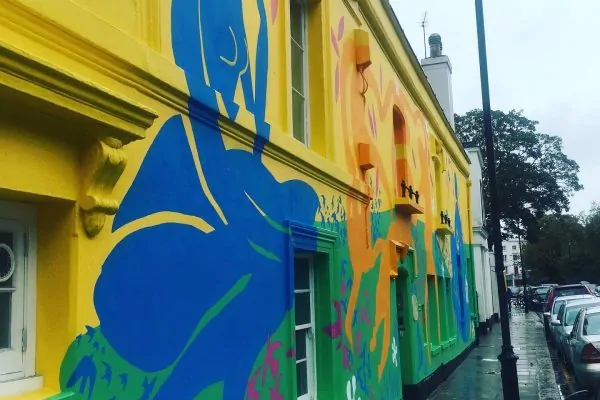
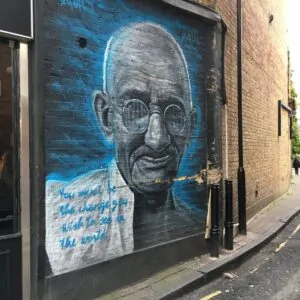
Images. Gandhi mural by Gnasher, corner of Dibden Street and Essex Road, Islington N1 · LOVE by Robert Indiana, Tate Modern · remaining photographs via Pexels: Rozegold, Vaneet Raj, Al Ameen Studios.
Alex Golding
BACP-Registered Psychosynthesis Counsellor
Ready to Talk?
Ready to start, or want to ask a question first - either way, I’d be glad to hear from you.